

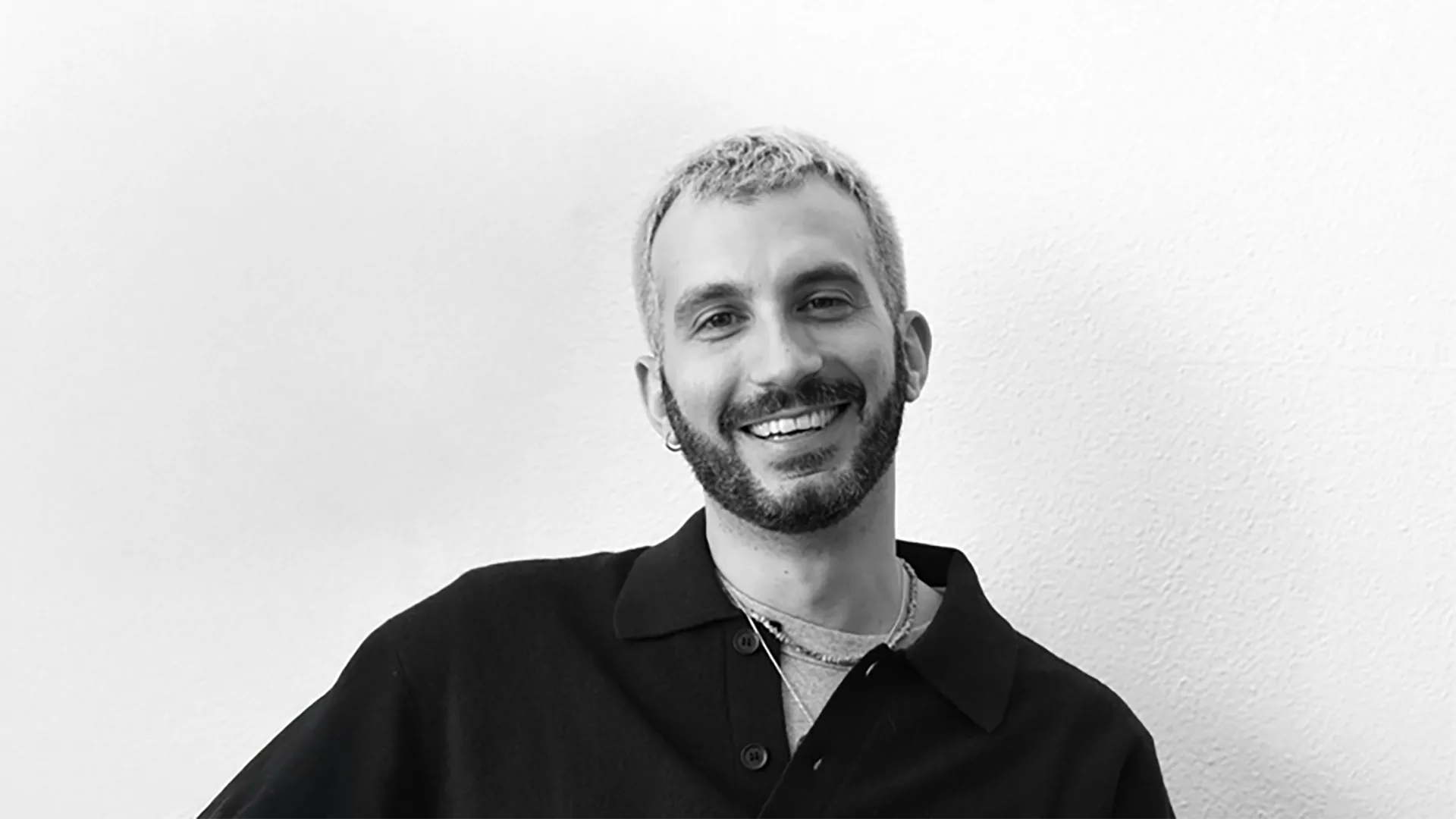
Introduce yourself and tell us your story and what you did today at Ferrari Fashion School.
I’m Andrea Bandiera, Senior Recruitment and Creative Manager at Lagente, an agency based in Milan that has been representing fashion designers and guiding them through their professional journey since 1994. I’ve been working for Lagente for almost 10 years. Before this experience, I managed productions for editorial shoots and wrote articles focused on fashion and culture for the independent magazine RedMilk. Since 2012, I’ve been a registered journalist, and I recently became Editorial Director of STELLA Publication.
Today, I met with a selected group of third-year students at Ferrari Fashion School for a portfolio review session.
How would you define a good portfolio for a young designer?
I believe there are a few key points to follow: a clean, well-structured layout that allows for immediate readability by whoever is reviewing the material; smart use of white space and fonts; a strong selection of high-resolution images; and a deep visual research component. The portfolio should clearly tell the story of the designer’s creative process. That’s why it’s important to document every step taken — including fitting moments (when possible) — and different design methods.
What elements do you consider essential to impress you?
Curiosity and creative hunger.
What qualities and skills do you look for in young talents aspiring to creative roles?
The ability to translate one’s thinking into something that can be understood by any audience. When something personal, abstract — a vision — is suddenly brought to life through volumes, shapes, and materials. An almost obsessive attention to detail… nothing should ever be taken for granted.
It’s about knowing how to be, knowing how to do, and knowing how to exist within a space.
Research, and how it is conducted, is just as important.
Also, I’d say today it’s essential to be sustainable — each person in their own way and with their own means. I believe it’s impossible to ignore this aspect, because doing so would mean not being a child of your time.
What advice would you give third-year fashion design students to stand out in today’s competitive market?
Thoroughly study the existing landscape, whether you’re looking to gain experience within a company (which I believe is a necessary and fundamental step) or planning to launch your own personal project.
You need to know the data, the numbers, the industry professionals in order to engage with the fashion world.
It’s essential to go to stores, touch the products, study the construction of garments, and identify both strengths and areas for improvement. Ask questions to sales staff to understand how the market is performing and better grasp customer behavior.
It’s important to enrich your education with content beyond just fashion. You need to broaden your horizons through research, which shouldn’t be limited to the digital realm — it should also happen in real life.
This means observing places and people, noticing how they interact with the outside world and their inner selves.
It’s crucial to engage with your peers, to listen to different perspectives and share generously — because only then can you truly be open to receiving in return.
And last but not least, never stop being curious. Seek unexpected connections, encourage encounters, and use them as opportunities to make your voice heard and affirm your vision.
How do you think culture and international experiences can influence the growth and development of an emerging designer?
International experiences are incredibly important. Exposure to different cultures is essential to enrich your perspective with new nuances and to experiment with new techniques and languages — all of which will definitely prove useful in the design process.
How do you think a young designer’s personal creativity can stand out in today’s competitive market?
I believe a young designer’s creativity can emerge in today’s market when there’s a clear, precise, and authentic vision. When the project is something the designer deeply believes in — something that clearly expresses their identity.
Of course, this vision will need to interact with modern realities and market logic, with the data and numbers I mentioned earlier.
Engaging with these realities doesn’t mean compromising your vision — it means finding your place in the world by doing what you love. And for it to be successful, it needs to resonate.
It’s certainly not an easy task.
What is the value of expressing your creative identity in your portfolio?
The opportunity to leave a mark and be remembered for your personal point of view.
That doesn’t necessarily mean doing something wild — it means having a clear and precise vision. Knowing your target customer, identifying your market, and building a world and imagery around your creativity.
You don’t need to make a lot of noise, especially in times like these.
You can speak softly — but be remembered for how and what you say. This applies to fashion too.
