

Riccardo Sciutto on Longevity in Luxury at Ferrari Fashion School
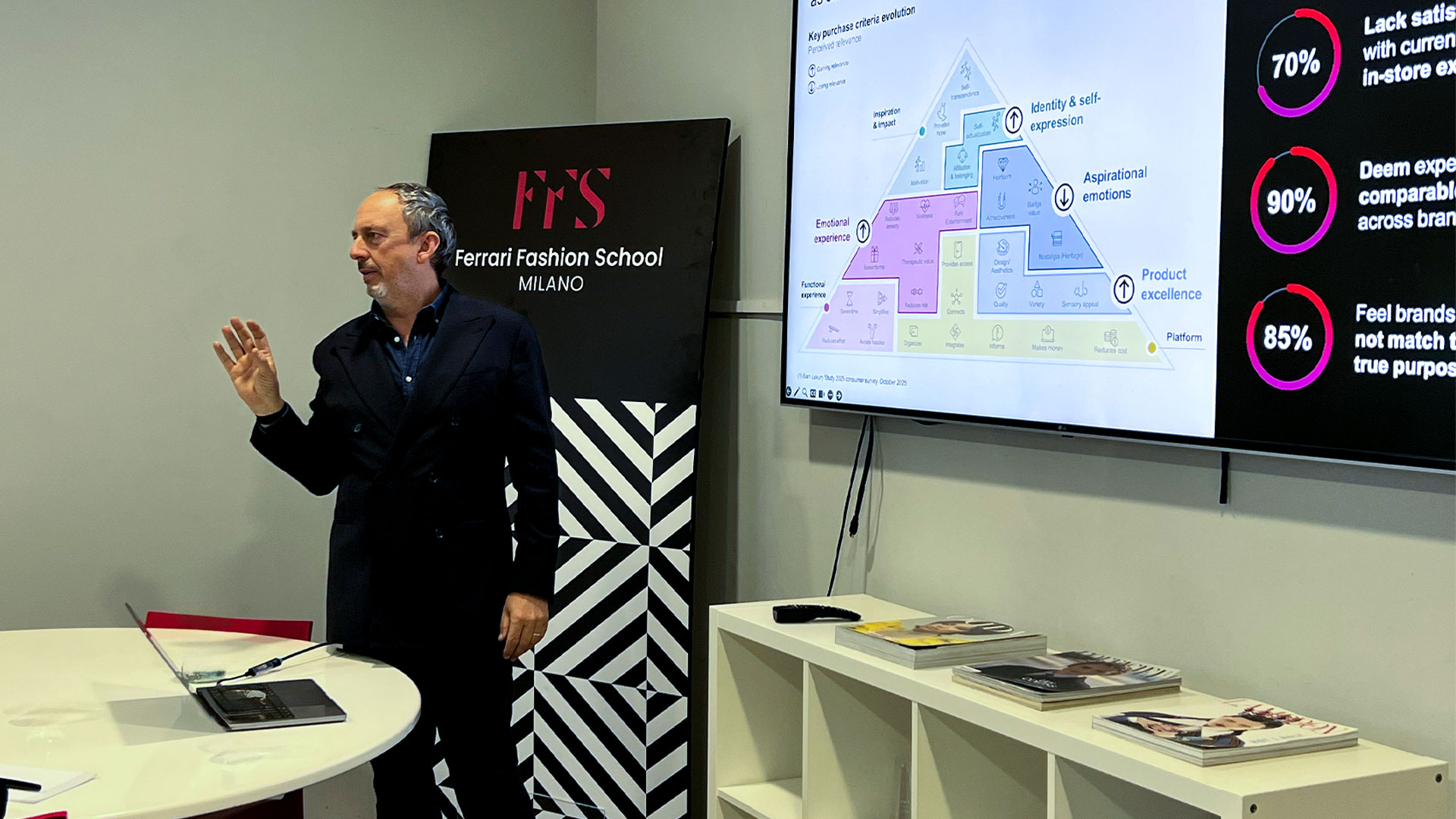
What does it mean for a luxury brand to “remain relevant” in a world that never stands still?
At Ferrari Fashion School, students from all disciplines gathered for a guest lecture that moved beyond operational strategy into a deeper reflection on leadership, identity, and change in the luxury industry. The session welcomed Riccardo Sciutto, former CEO of Sergio Rossi, former senior executive at Hogan, board member of the Fondazione Altagamma and former president of Cercal, the international footwear school founded in Italy’s shoemaking district, known for guiding heritage brands through phases of transformation in an increasingly unstable global market.
Luxury as a System of Tension
Rather than presenting fixed frameworks, Sciutto approached luxury as a system defined by constant tension: between heritage and reinvention, stability and disruption, intuition and data – and he really shared insider’s financial figures about the luxury industry. In a context where the luxury industry is still adjusting to post-pandemic recalibration, slowing growth patterns, and shifting consumer values, his perspective raised a more fundamental question: what does it actually mean to lead a brand today?
A recurring idea in the discussion was uncertainty. Not as a problem to eliminate, but as a condition to operate within. In this sense, decision-making becomes less about certainty and more about interpretation: the ability to read signals, understand timing, and respond without losing coherence. This became tangible through examples he offered, from managing the rise of resale and vintage not as a threat to luxury but as part of its evolving ecosystem, to rethinking the value of the physical store as a site of experience, not merely transaction.
What Defines Relevance?
Sciutto also questioned how brands define “relevance.” Is relevance something constructed internally through strategy, or externally through cultural perception? And if identity must evolve continuously, at what point does a brand stop being itself? His reflections on omnichannel thinking and experiential retail pushed this further, suggesting that relevance today may depend less on product alone than on how brands orchestrate meaning across touchpoints.
These questions framed a broader reflection on listening as a strategic capability. In Sciutto’s view, brands fail not only when they misread markets, but when they stop listening altogether, to people, to context, and to change itself.
As he stated during the lecture: “Fashion experiences its greatest crisis when it stops listening to people.”
Rethinking Longevity
For the students in attendance, the session became less about predefined answers and more about perspective. In a luxury landscape shaped by constant acceleration, the key challenge is no longer simply how to grow, but how to stay conscious while evolving; and whether true longevity is even possible without continuous self-questioning.
