

How do brands construct meaning when identity is no longer communicated only through product, but through space, culture, and experience?
During Milan Design Week, ISG Students explored multiple exhibitions as part of their module on Brand Synergy: Advanced Marketing & Brand Management and engaged with this question through a structured immersion across Milan. The experience was developed within the academic framework of their course at Ferrari Fashion School and, for the Design Week day experience, coordinated on site by Federica Patta, a lecturer at the school and brand consultant, who accompanied the students throughout the day.
Analytical Frameworks in Brera
The day began in Brera with a morning session focused on cultural positioning and brand experience analysis. Under Patta’s guidance, students were introduced to analytical tools used to examine how brands construct storytelling, positioning, and perception. Each student selected one brand, which they would later develop into a focused analysis of its target audience, visual language, and customer journey within their academic work. The session provided a framework for decoding how immersive physical environments translate abstract values into tangible experience. The discussion also addressed how culture influences brand perception, as well as the role of intangible mechanisms such as repetition, authority, and consistency in shaping identity over time.
From Observation to Activation
In the afternoon, the focus shifted toward brand experience and activation, where students explored how visual identity operates within large-scale spatial and event-based formats. This included examining collaborations and installations as strategic marketing tools, with attention to engagement design, audience interaction, and the key success factors behind experiential campaigns. Rather than observing brands as static entities, students analysed how meaning is activated through participation, movement, and sensory design.
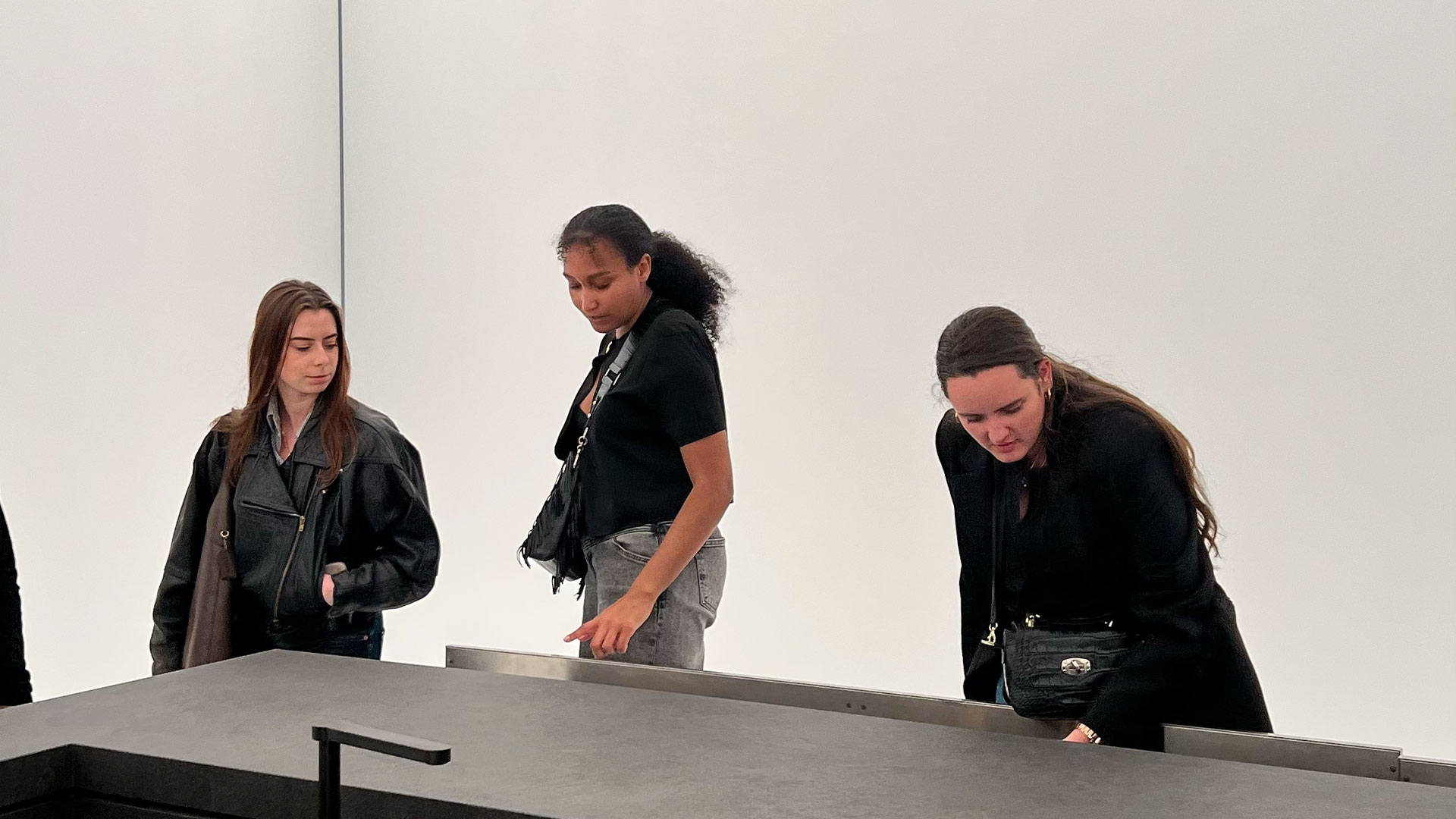
Across Milan Design Week, students moved through installations not as visitors, but as analytical observers, comparing how different brands construct narrative systems through material, atmosphere, and cultural framing. The exchange format added depth to this process, allowing diverse perspectives to shape collective interpretation.
Case Studies Across Milan
From Arket’s experiential storytelling to immersive environments such as ELLE Decor’s “Sensory Lands,” Bugatti Home, Geely Anima Mundi, and Rimadesio at Palazzo Isimbardi, each stop revealed a different strategy of spatial communication.
Within this framework, Milan Design Week functioned as a live pedagogical environment where Federica Patta’s structured approach enabled students to translate observation into interpretation, and experience into analytical understanding of contemporary brand systems, which would be later incorporated in their project work.
