

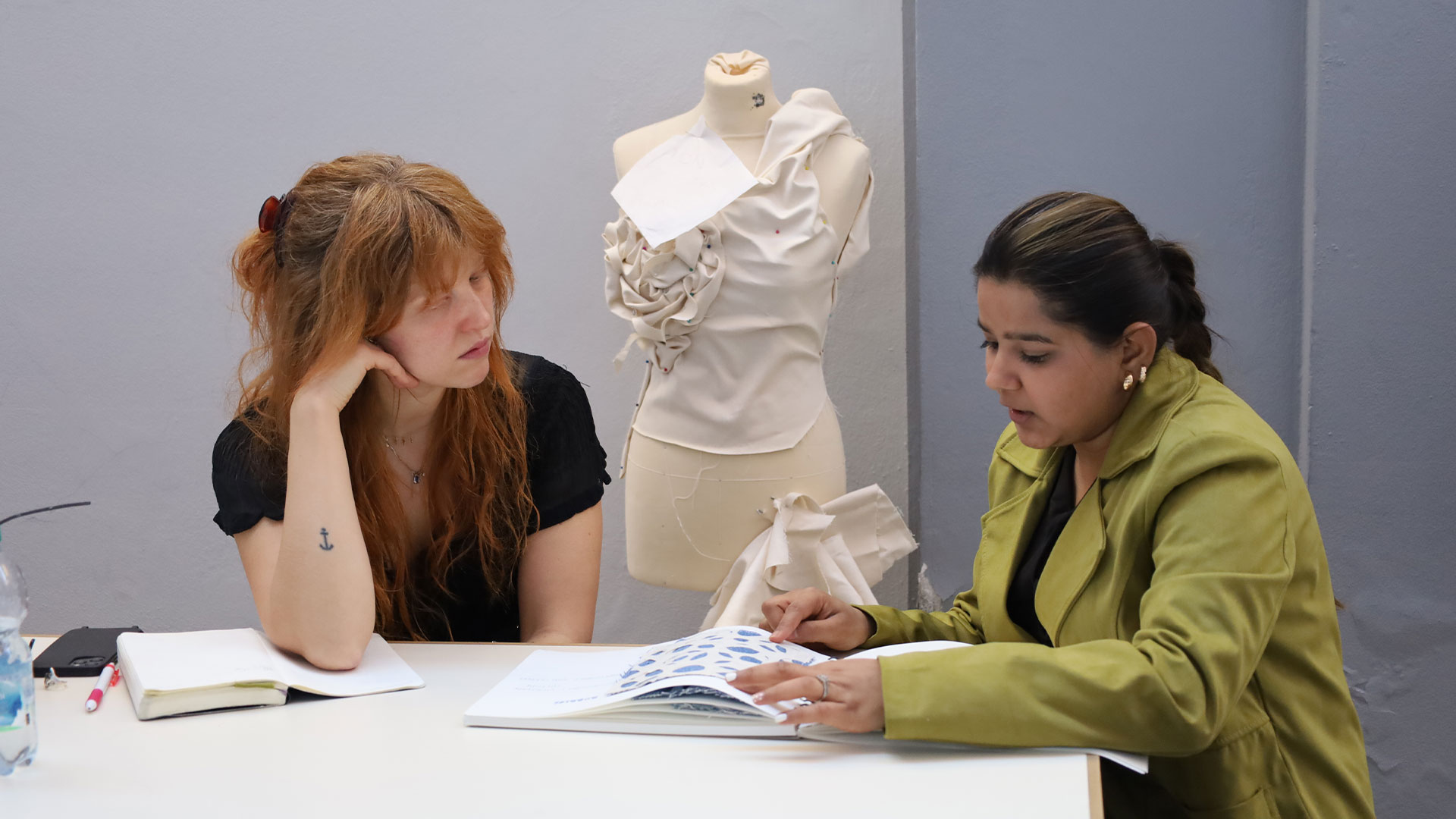
Flora Rabitti brings material experimentation and craft-based research into Ferrari Fashion School’s Materials and Tailoring module
What does it mean to treat fabric not as a starting material, but as a space for research?
Within the Materials and Tailoring module of the Master of Arts in Fashion Design and Creative Direction at Ferrari Fashion School, Flora Rabitti led a 4-week course on fabric manipulation that invited students to approach textiles through experimentation. Founder of Florania, consultant for Max Mara, and part of a new generation of fashion designers redefining the relationship between craft, sustainability and innovation, Rabitti brought into the classroom a methodology deeply rooted in material intelligence.
Developing Authorship Through Making
Rather than framing fabric manipulation as a purely technical exercise, the course positioned it as a way of developing authorship through making. Students worked through surface interventions, natural dyeing and textile prototyping, culminating in sample books that gathered manipulated structures, color studies and material explorations into a process-led archive of research.
Extending Learning Beyond the Studio
What made the experience particularly distinctive was the way Rabitti extended learning beyond the studio. In her hometown, students engaged with natural dyeing using organic materials and entered a more intimate dimension of practice, one connected to place, ritual and everyday making. Time spent in her home environment, including moments of shared exchange beyond formal teaching, gave the course an uncommon human depth and reflected the relational dimension of her approach.
Material-Led Design in a Changing Industry
In the broader context of contemporary fashion, Rabitti’s approach aligns with a growing shift toward material-led design and regenerative thinking, increasingly visible across both luxury houses and independent labels. As the industry responds to new EU sustainability frameworks and rising pressure for traceability in production systems, experimental craft practices and small-scale material research are gaining renewed relevance. Within this landscape, her work sits at the intersection of education and practice, where tactile experimentation becomes a way of responding to structural changes in how fashion is designed and produced.
When Materials Lead the Design Process
In the Master of Arts in Fashion Design and Creative Direction, where Rabitti’s approach sits at the core of our pedagogy, the answer does not begin in theory but in the slow logic of making itself, which students adopt and develop to shape their own collections.
