

How does sustainability shift from regulatory language into operational reality?
In a context where several Italian fashion brands have recently faced reputational and legal challenges linked to supply chain malpractice, labour conditions, and insufficient oversight of production networks, questions around transparency and accountability have become extremely urgent for the industry. As European ESG frameworks and corporate accountability standards continue to tighten across value chains, this issue is becoming central not only for brands, but also for the future professionals shaping them.
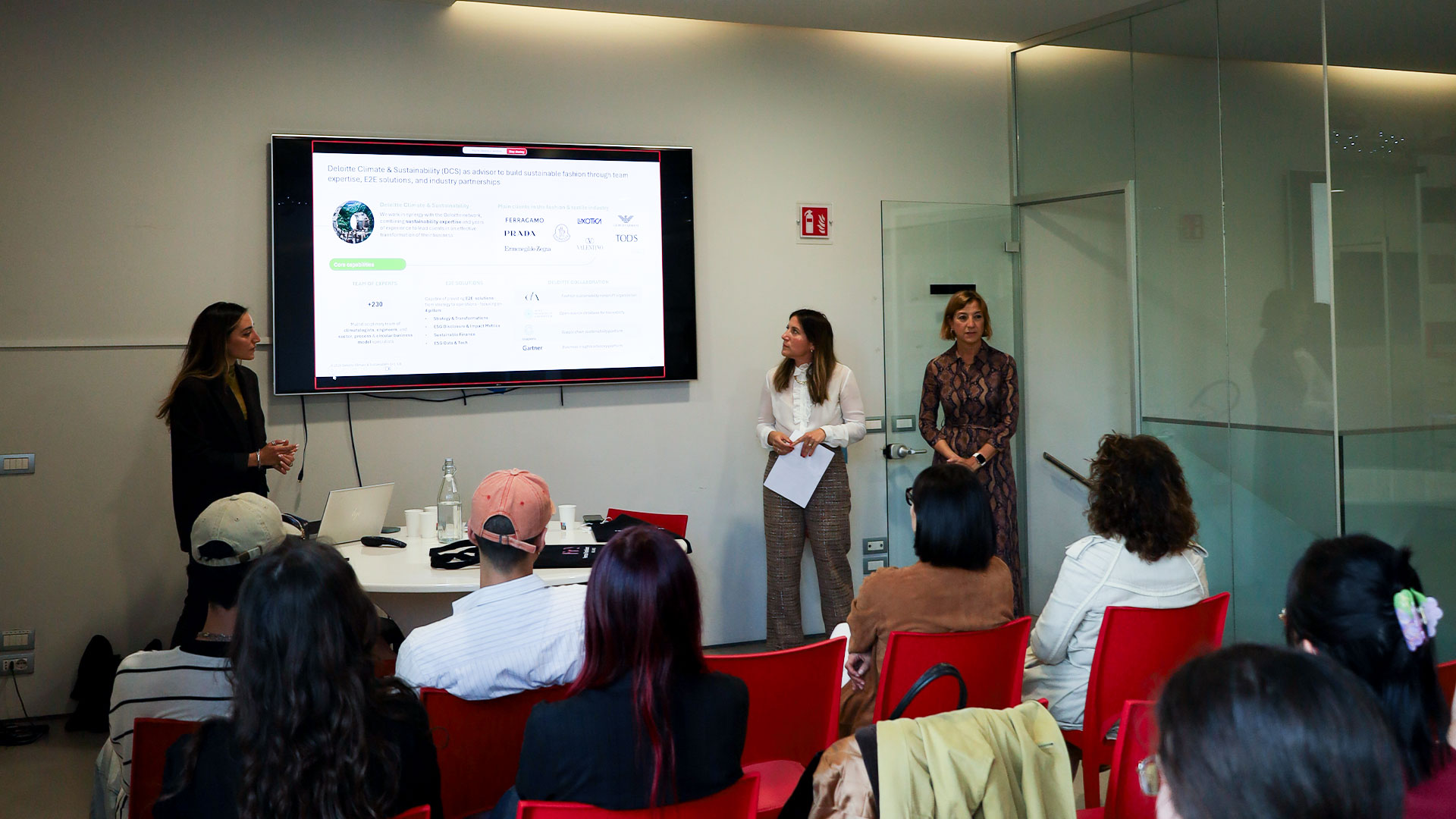
This was the context of the Fashion Impact Toolkit presentation held on 20th May at Ferrari Fashion School, featuring Beatrice Lamonica, engineer and Partner at Deloitte Climate & Sustainability, and Sonia Belloli, lawyer and Managing Associate in Corporate Compliance & ESG at Deloitte Legal. The session brought together both undergraduate and postgraduate students in Fashion Design, Styling and Communication, Business and Management in a cross-discipline format focused on how sustainability is structured, regulated, and implemented in today’s fashion system.
Sustainability under regulatory pressure
European regulatory framework around sustainability is rapidly evolving, including the Corporate Sustainability Reporting Directive, the Corporate Sustainability Due Diligence Directive, the EU Taxonomy Regulation, and especially the Ecodesign for Sustainable Products Regulation and the Digital Product Passport, sustainability is no longer positioned as a voluntary brand narrative. Instead, it operates as a structured system of legal obligations that directly shapes how companies design, source, produce, and communicate.
Beatrice Lamonica, working at the intersection of climate strategy and corporate transformation within Deloitte Climate & Sustainability, outlined how sustainability now functions as an operational framework embedded in business decision-making. Her perspective emphasized the shift from intention to implementation with significant case studies.
Alongside her, Sonia Belloli, focusing on corporate compliance and ESG at Deloitte Legal, addressed the legal infrastructure behind this transformation. Her presentation highlighted how regulatory frameworks define the boundaries of action for fashion companies, particularly in areas such as reporting standards, governance models, and accountability mechanisms.
From compliance to operational tools
Central to the session was the Fashion Impact Toolkit, developed by Deloitte Global and the Global Fashion Agenda, presented as a working methodology that translates complex regulatory requirements into practical instruments for industry use. Built around a lifecycle and circularity perspective, the framework considers not only product development and supply chain transparency, but also durability, repairability, resale, recycling, textile waste management, reverse logistics, and material recovery systems. The objective is to integrate ESG requirements directly into how fashion products are conceived, produced, distributed, used, and reintroduced into the circular economy.
Rethinking how fashion operates today
The discussion ultimately reframed sustainability not as a conceptual direction, but as a structural condition of contemporary fashion practice. At the same time, it exposed a growing tension within the industry: although design decisions are estimated to determine the majority of a product’s environmental impact, creative directors and design teams often remain marginally involved in the implementation of sustainability assessment tools and circularity strategies. This opens a significant opportunity for the future: if fashion schools are able to train a new generation of designers capable of combining creative vision with lifecycle thinking, design itself could become the industry’s most effective driver of sustainable transformation.
