

POV By Chiara Dussini | Course Leader BA Fashion Business and Digital Marketing*
The Venice Sustainable Fashion Forum 2026 highlighted an increasingly urgent challenge for the fashion industry: turning sustainability from a statement of intent into a strategic driver of competitiveness through transparent supply chains, technological innovation and new professional skills.
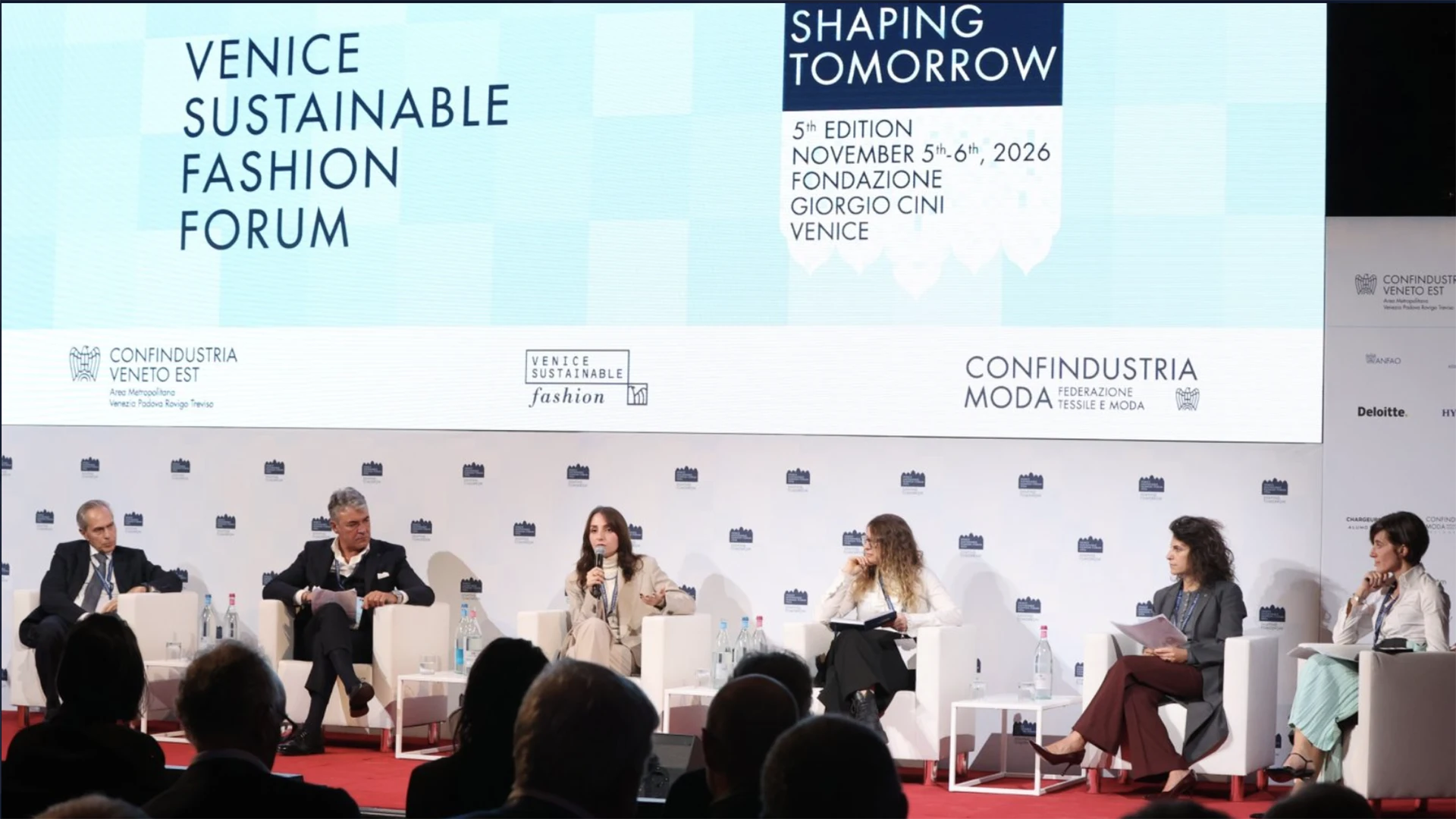
The fifth edition of the Venice Sustainable Fashion Forum, which I followed online and through discussions with colleagues who attended in person, marked an interesting shift: less rhetoric, more research, data and debate on the industry’s most pressing challenges. This does not mean that politics was absent from the Forum. On the contrary, Venice provided a platform for specific demands addressed to Italian and European policymakers.
From Sustainability Commitments to Sustainable Practices
The theme of this year’s edition, Shaping Tomorrow, looked towards the future. The discussions, however, remained firmly grounded in the present. At the Fondazione Giorgio Cini, on 5 and 6 November, the focus was on supply chain compliance, working conditions and the need to monitor subcontracting beyond first-tier suppliers. The message was unequivocal: integrity is non-negotiable.
This is the issue that resonates most strongly with me. Sustainability has two essential dimensions, environmental and social, and for years the fashion industry has focused predominantly on the former. Today, we know that a garment cannot be considered sustainable simply because its fabric is environmentally responsible if the people who made it work under unacceptable conditions.
There is still a long way to go on both fronts. TEHA‘s Just Fashion Transition 2026 study makes this clear: circular business models become economically viable only when innovation reaches industrial scale. This requires investment, expertise and collaboration across the entire fashion supply chain. The figures reveal the gap: companies currently invest 3.3% of their turnover in innovation, but only around one percentage point is allocated to sustainability objectives.
Why Sustainability Remains a Strategic Priority for the Fashion Industry
Yet sustainability did not emerge from Venice diminished. It emerged as a more mature strategic priority. It can no longer remain simply a section of a corporate report or a communication exercise. It must become a condition for competitiveness: in global markets, in the eyes of consumers and within an evolving European regulatory framework.
But if sustainability is genuinely a competitive advantage, why do so many companies still regard it as a cost that can be postponed? And how can the investments required for sustainable transformation be reconciled with increasing pressure on prices and margins throughout the supply chain?
Companies that continue to treat sustainability as a cost to defer risk being excluded from the supply chains that matter. Those that approach it as an industrial investment, alongside technology and human capital, can build a lasting competitive advantage. This, to me, is the significance of the Forum’s vision for 2035.
The proposal put forward by Luca Sburlati, President of Confindustria Moda, points in the same direction: a genuine supply chain pact, based on a ten-year industrial strategy, bringing together fashion brands, manufacturers and institutions. As he emphasised, protecting Made in Italy means enabling Italian manufacturing to evolve.
This is where I believe greater emphasis is needed. Sustainability must increasingly become a genuine strategic driver, embedded in industrial decisions rather than confined to plans and reports. It can also become something more: a source of competitive differentiation.
A Made in Italy fashion industry capable of demonstrating how, where and by whom a product is made throughout its supply chain is a more credible one. Made in Italy should not simply be a label to protect, but a value that can be verified. The challenge is to make this level of transparency accessible to the small and medium-sized enterprises that form the backbone of Italian fashion manufacturing.
Artificial Intelligence and Sustainability: Allies, but Under What Conditions?
One of the emerging topics was artificial intelligence, to which the Forum dedicated a session exploring its applications across the fashion supply chain. Reports from the event painted a realistic picture: the industry recognises AI’s potential, but concrete applications remain relatively limited.
I believe this is precisely where sustainability and AI intersect. Supply chain traceability, demand forecasting to reduce unsold inventory, minimising fabric waste during cutting and measuring environmental impacts through reliable data are all sustainability challenges that artificial intelligence can help address.
But does making a process more efficient necessarily make it more sustainable? And what happens if AI is primarily used to accelerate production, further contributing to overproduction?
AI can be a powerful ally, but only when guided by a clear strategic direction. It amplifies a company’s decisions; it does not replace them. Without a genuine commitment to sustainability, AI risks simply accelerating processes that are already unsustainable.
The Skills Challenge: Connecting Fashion Education and Industry
This brings me to the figure that struck me most: according to the findings presented at the Forum, 55.3% of the professional profiles sought by companies in the fashion industry are difficult to recruit. Neither the sustainable nor the digital transition can succeed without people who know how to put them into practice.
For those of us working in fashion education, this represents both a responsibility and a clear direction. We need to prepare professionals who can combine manufacturing expertise, environmental and ethical awareness, and the ability to use emerging technologies.
After all, sustainability is not a skill reserved for specialists. It shapes the decisions of fashion designers, from material selection and designing durable products to reducing production waste. But it is equally relevant to fashion business professionals: from supplier selection and collection planning to cost management and the development of circular business models.
This is an approach we seek to integrate into education at Ferrari Fashion School in Milan, addressing sustainability across both Fashion Design and Fashion Business programmes. In Fashion Design, it informs design decisions, material selection and production processes. In Fashion Business, it becomes part of strategic decision-making, supply chain management and the evaluation of business models.
Because designing and managing fashion more responsibly requires different professional skills, but a shared Manifesto.
Chiara Dussini is a lecturer on the BA (Hons) Fashion Business & Digital Marketing programme at Ferrari Fashion School and President of ANTIA – Associazione Nazionale Tecnici dell’Industria dell’Abbigliamento (Italian Association of Apparel Industry Technicians). She holds a degree in Economics and International Marketing and a Master’s in European Management. She has extensive experience as a Product and Marketing Manager for Italian and international premium and luxury companies. A consultant specialising in marketing and brand strategy, she combines her professional practice with teaching in fashion business, digital strategy and luxury management. Her work focuses on promoting Italian manufacturing expertise and strengthening the dialogue between industry, innovation and education.
*This article is part of POV – Point Of View, a column by Ferrari Fashion School that gives a voice to its faculty, allowing them to interpret, discuss, and challenge the transformations within contemporary fashion.
