

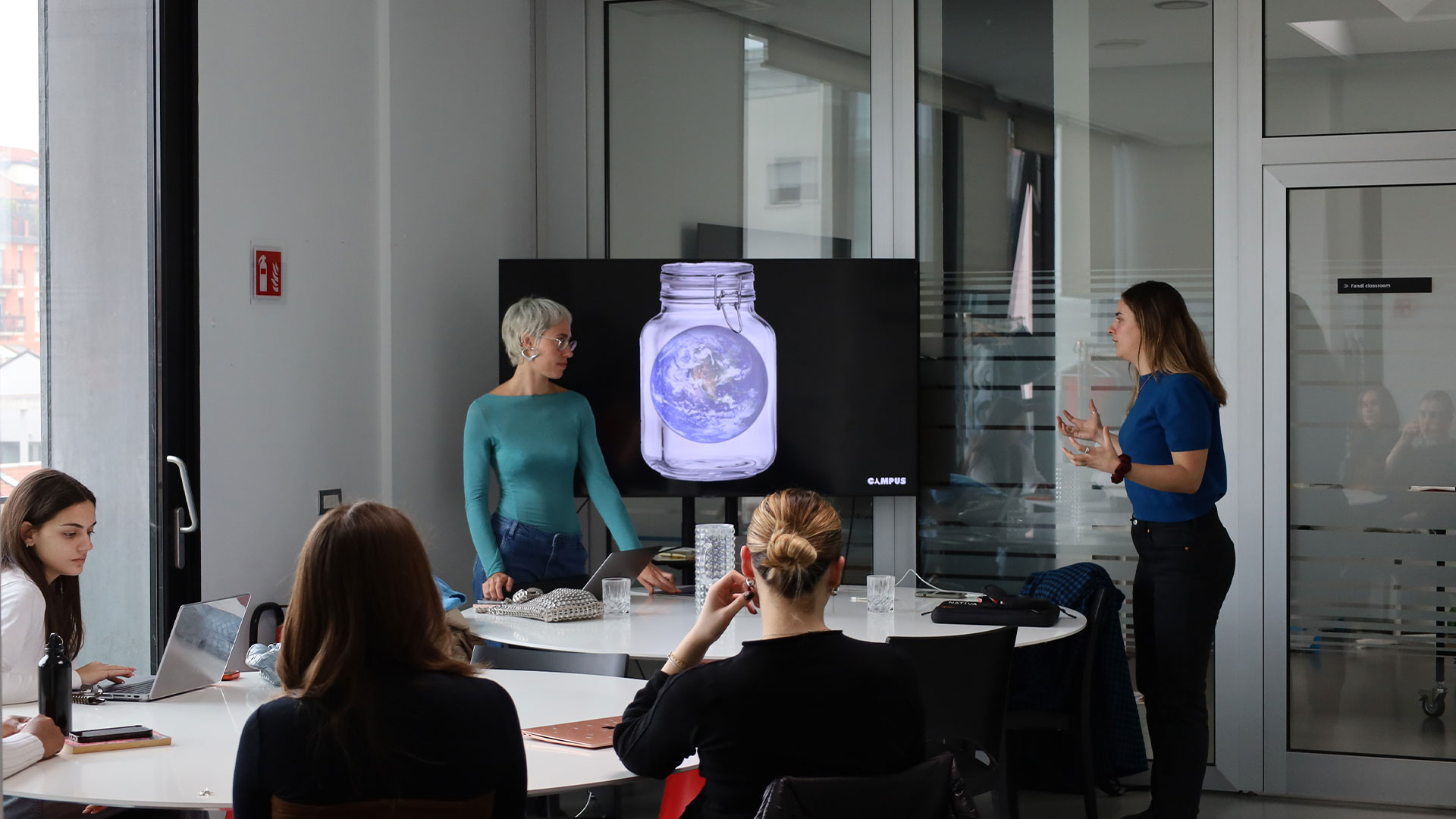
How can education prepare fashion professionals to navigate the transition towards more sustainable and regenerative models?
Ferrari Fashion School and Nativa collaborate to bring these topics directly into the education of the next generation of fashion designers and managers.
The collaboration has enriched the Master of Arts in Fashion Design and Creative Direction and the Master of Arts in Fashion and Luxury Management with a module dedicated to regenerative fashion.
The learning experience was designed to provide students with practical tools to understand the transformation of the fashion system and envision new approaches to design and business.
Ferrari Fashion School and Nativa: Education for Sustainable Fashion
The collaboration brings together education, innovation and sustainability.
Ferrari Fashion School prepares professionals to interpret the evolution of fashion through an approach that combines culture, design and practical experience.
Nativa, a pioneering Italian Benefit Corporation specialising in strategic sustainability consulting, supports companies and organisations in their transition towards regenerative models.
Together, they bring sustainability in fashion beyond theory, making it a subject for analysis, design and experimentation.
What Is Nativa and What Does It Do?
Nativa supports companies and organisations in their transition towards regenerative paradigms.
Its approach integrates the United Nations 2030 Agenda Sustainable Development Goals (SDGs), circular economy principles, environmental regeneration and social equity into decision-making and production processes.
Nativa also works with companies and organisations to define sustainability strategies, measure impact and develop models designed to generate value for businesses, people and the planet.
This expertise became part of the Ferrari Fashion School educational experience through a module specifically focused on the future of the fashion system.
What Is Regenerative Fashion?
Regenerative fashion is an approach that aims to go beyond simply reducing negative impacts.
It encourages designers, managers and companies to rethink products, materials, supply chains and business models by considering the environmental and social consequences of their decisions.
For future fashion professionals, this means learning to consider the entire lifecycle of a product and understand the relationships between design, production, business, territories, people and resources.
A Learning Module Dedicated to Regenerative Fashion
The module included in Ferrari Fashion School’s Master’s programmes was led by two Nativa professionals: Giulia Belpoliti, Evolution Guide & Circular Fashion Expert, and Letizia Vanni D’Archirafi, Sustainability Consultant.
Through lectures, case studies and practical exercises, they guided students through an intensive learning experience focused on regenerative fashion.
The aim was to explore the main challenges and opportunities involved in developing a more ethical, transparent and sustainable fashion supply chain.
From Sustainability to Regeneration
The module encouraged students to consider sustainability as an integral part of creative and managerial decision-making.
Rather than an element to be added at the end of the process, sustainability becomes a perspective through which materials, products, supply chains and business models can be assessed from the earliest stages of a project.
This approach connects the skills of fashion designers and fashion managers with the transformations currently reshaping the industry.
From Theory to Action: What Students Explored
One of the central aspects of the project was turning theoretical knowledge into practical application.
During the module, students explored key topics related to the sustainable transformation of the fashion system:
- United Nations 2030 Agenda SDGs and integrated sustainability principles;
- analysis of the fashion supply chain;
- material sourcing and selection;
- international certifications;
- development of sustainable and circular products;
- tools and criteria for impact measurement;
- development of new business models;
- creation of regenerative-impact fashion startup concepts.
These activities enabled students to apply their knowledge to the development of innovative models for their own design and management projects.
Designing New Business Models for Fashion
The transition towards sustainability requires skills that extend beyond material knowledge.
Fashion professionals need to understand how decisions made throughout the supply chain can affect products, people, the environment and a company’s business model.
Students were therefore also challenged to envision fashion startups and new business models through a regenerative perspective.
The exercise transformed the principles explored during the module into concrete project concepts, connecting sustainability with innovation and entrepreneurship.
Educating Fashion Designers and Managers for a Changing Industry
The collaboration with Nativa is part of Ferrari Fashion School’s educational approach, which encourages students to engage with professionals and organisations from the industry.
The two Master’s programmes address the transformation of fashion from complementary perspectives.
The Master of Arts in Fashion Design and Creative Direction explores design, materials, fashion making, visual communication and creative direction.
The Master of Arts in Fashion and Luxury Management focuses on business strategies, value chain management and the operational activities of fashion brands.
Integrating regenerative fashion education into these programmes means preparing both the professionals who will design products and shape brand identities and those who will contribute to defining business strategies and future development models.
Ferrari Fashion School: Innovation, Sustainability and Fashion Culture
The collaboration between Ferrari Fashion School and Nativa demonstrates how education can become a space in which industry transformation is explored through concrete experiences.
For students, it means engaging with professional expertise, case studies and emerging models before entering the workplace.
For Ferrari Fashion School, it means continuing to develop an educational approach that connects creativity, technical expertise and business with environmental and social awareness.
The goal is to prepare a new generation of fashion designers, creative directors and fashion managers who can not only adapt to industry transformation, but actively contribute to shaping its evolution.
Discover the Master of Arts programmes at Ferrari Fashion School and develop the skills to contribute to the future of fashion and luxury.
