

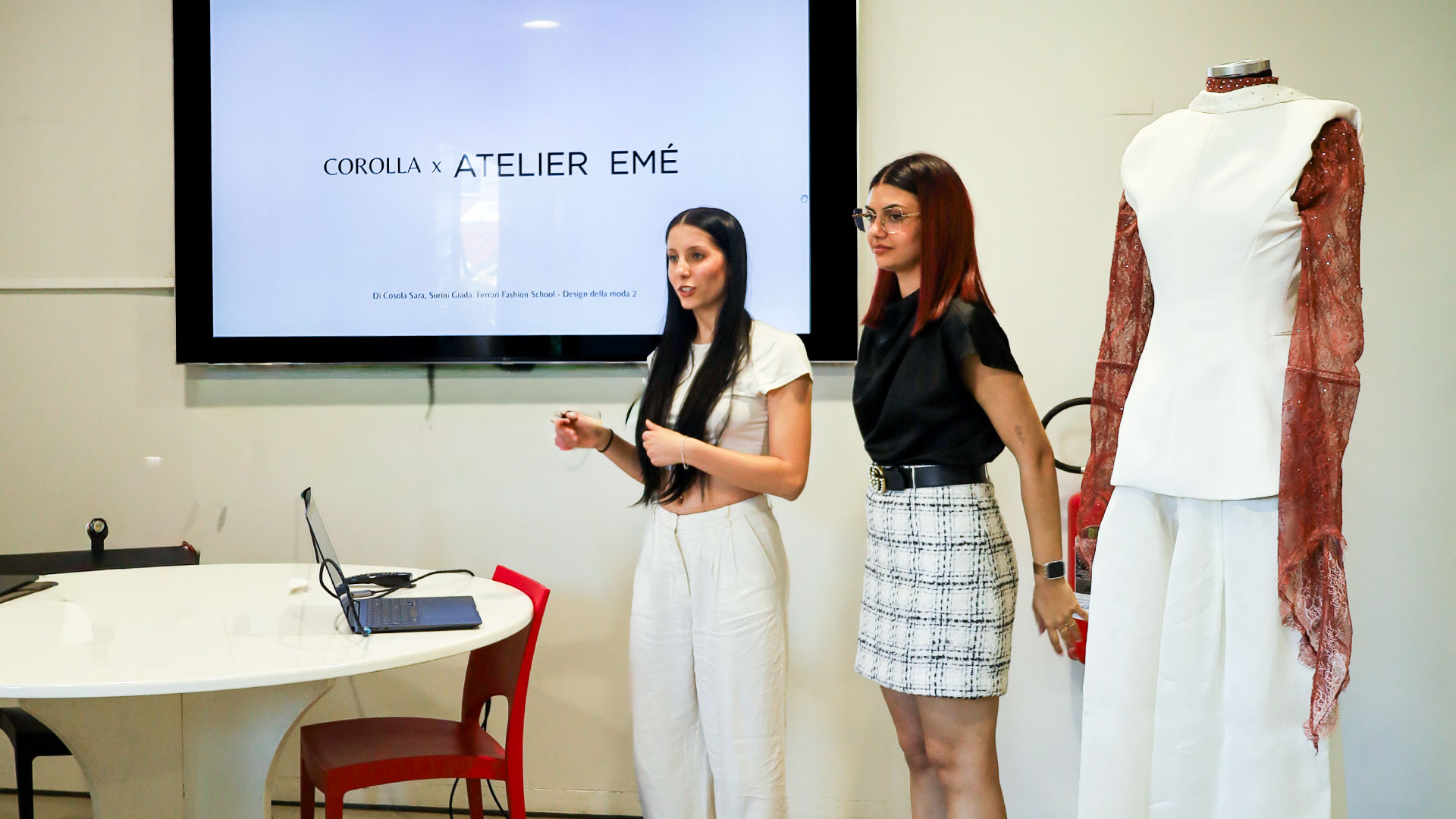
What happens when heritage garments are no longer treated as finished products, but as starting points for transformation? At Ferrari Fashion School, second-year students from the Undergraduate course in Fashion Design and the Bachelor of Arts in Fashion Design engaged with this question through a collaborative project developed in partnership with Atelier Emé, part of the Oniverse group. Atelier Emé is an Italian maison specialised in bridal and ceremony wear, known for its refined craftsmanship, attention to detail and contemporary interpretation of femininity. Running throughout the second semester of 2026, the initiative challenged students to rethink authorship, material value and sustainability through the upcycling of existing garments.
From archival pieces to contemporary proposals
The project was developed under the supervision of Giusy Liguori and Gilberto Calzolari, both bringing extensive industry experience into the academic framework. Giusy Liguori, fashion designer, creative director, lecturer and course leader of the BA in Fashion Design, has worked across international luxury and prêt-à-porter environments, collaborating with brands including Etro, Costume National and Rena Lange before founding her own fashion and fine jewelry label, 6229.
Alongside her, Gilberto Calzolari contributed a perspective deeply rooted in sustainable fashion and craftsmanship. After more than fifteen years working with houses such as Marni, Valentino, Miu Miu and Giorgio Armani, he launched his own Milan-based sustainable prêt-à-porter label in 2015, later receiving recognitions including the Franca Sozzani Green Carpet Fashion Award.
Sustainability as a creative methodology
Students worked with approximately 70 Atelier Emé garments from previous bridal and ready-to-wear collections, transforming them through tailoring deconstruction, textile manipulation, embroidery and dyeing techniques. Rather than designing from scratch, the project positioned creativity as an act of reinterpretation, where heritage becomes material for experimentation.
Working in pairs, students developed ten final proposals through a process spanning research, concept development, prototyping and final production. Atelier Emé remained actively involved throughout the project, participating in guest talks, reviews and the final selection process, offering internship positions to top-qualifying students.
Bridging education and industry
Within a fashion landscape increasingly shaped by circularity and responsible production models, the collaboration reflects a broader industry shift toward regenerative design thinking. The project encouraged students to approach sustainability not as a limitation, but as a framework for innovation, balancing craftsmanship, experimentation and contemporary relevance through direct engagement with industry realities.
